Your gate motor (the operator) is the heart of your automatic gate - and when it acts up, the symptom almost always tells us where to look. This guide walks through the most common gate motor complaints we hear, what each one usually means, and how we fix them. It applies to swing and sliding gates alike, from a single-family driveway in North Hollywood to a 200-unit parking gate in Van Nuys.
Symptom by Symptom: What Your Gate Motor Is Telling You
The motor hums, but nothing moves
The classic call. Nine times out of ten this is not a dead motor - it is a failed start capacitor (a cheap, fast fix), a stripped gear kit, or a gate that is physically binding so the motor cannot overcome the resistance. We test the capacitor, inspect the gears, and push the gate by hand in manual release to feel for binding before touching anything else.
The gate opens partway and reverses
Usually a safety input doing its job - a misaligned photo eye, a damaged loop detector wire, or an over-sensitive force setting. Sometimes it is a failing board misreading its limits. This is diagnosis work, not guesswork, and it is exactly what our electric gate repair visits are built for.
Clicking, but no hum at all
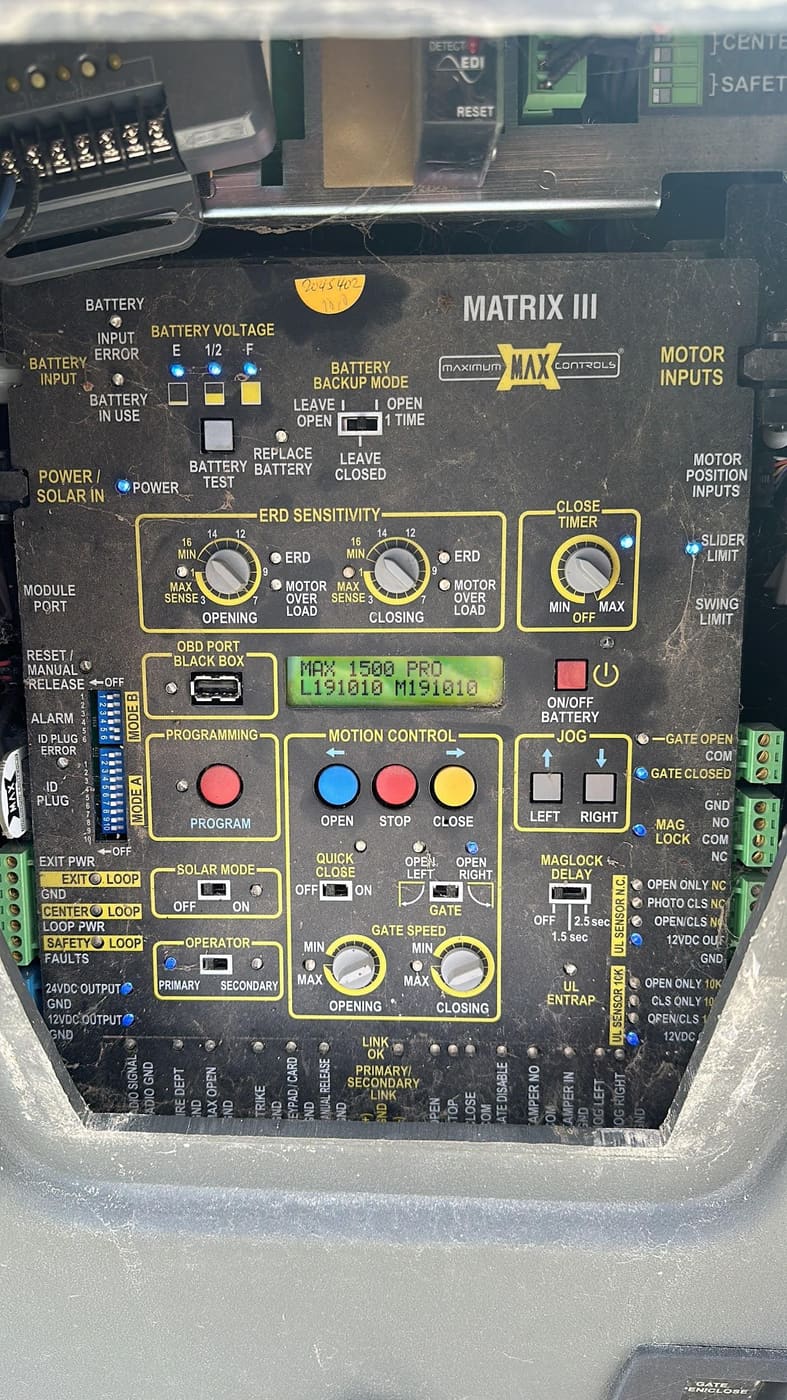
Points at the control board or a relay - or simply no power reaching the operator. We check the breaker, the transformer, the board fuses, and the battery backup before condemning any part.
The gate crawls, grinds, or screeches
Mechanical wear: dry or flat rollers, a bent track, sagging hinges, or a chain at the wrong tension. The motor is often fine - it is dragging a gate that no longer rolls freely. On wrought iron gates we also check for hinge wear and frame sag, which our wrought iron gate repair service corrects.
It works… sometimes
Intermittent faults are almost always electrical: a corroded connection, a water-damaged board, sun-baked wiring insulation, or a remote/receiver mismatch. Southern California heat is brutal on capacitors and boards - we see a spike in these failures every summer.
Repair or Replace the Operator?
Our rule is simple: if the motor windings and gearbox are healthy, repair wins. Boards, capacitors, limit switches, gear kits, chains, and receivers are all replaceable parts. Replacement becomes the honest recommendation when the operator is obsolete (no parts available), chronically underpowered for the gate’s weight, or has burned through repeated repairs. Then we size a new LiftMaster, DoorKing, Viking, Elite, All-O-Matic, or Eagle unit correctly as part of a professional gate opener installation - see our repair-or-replace guide for the full decision framework.
What a Gate Motor Repair Visit Looks Like
- Manual-release test - we isolate whether the problem is the motor or the gate itself.
- Electrical diagnosis - power, board, capacitor, limits, safety inputs, remotes.
- Written quote before work - parts and labor, no surprises.
- Repair from the truck - we stock common capacitors, boards, gear kits, and remotes, so most repairs finish in one visit.
- Full-cycle test and safety check - force settings, photo eyes, and loops verified before we leave.
Every job is done by fully insured technicians, backed by a 5.0 rating from 57 verified reviews.
Local, Fast, and Honest
We repair gate motors across two regions: the San Fernando Valley - from our home base in North Hollywood - and Riverside and the Inland Empire. Apartment and HOA parking gates are a specialty, and our commercial gate service includes maintenance plans that catch failing parts before tenants get stuck.
Gate not moving right now? Call (951) 903-5514 any hour, or book online - and ask about our new-customer, senior, and veteran discounts.